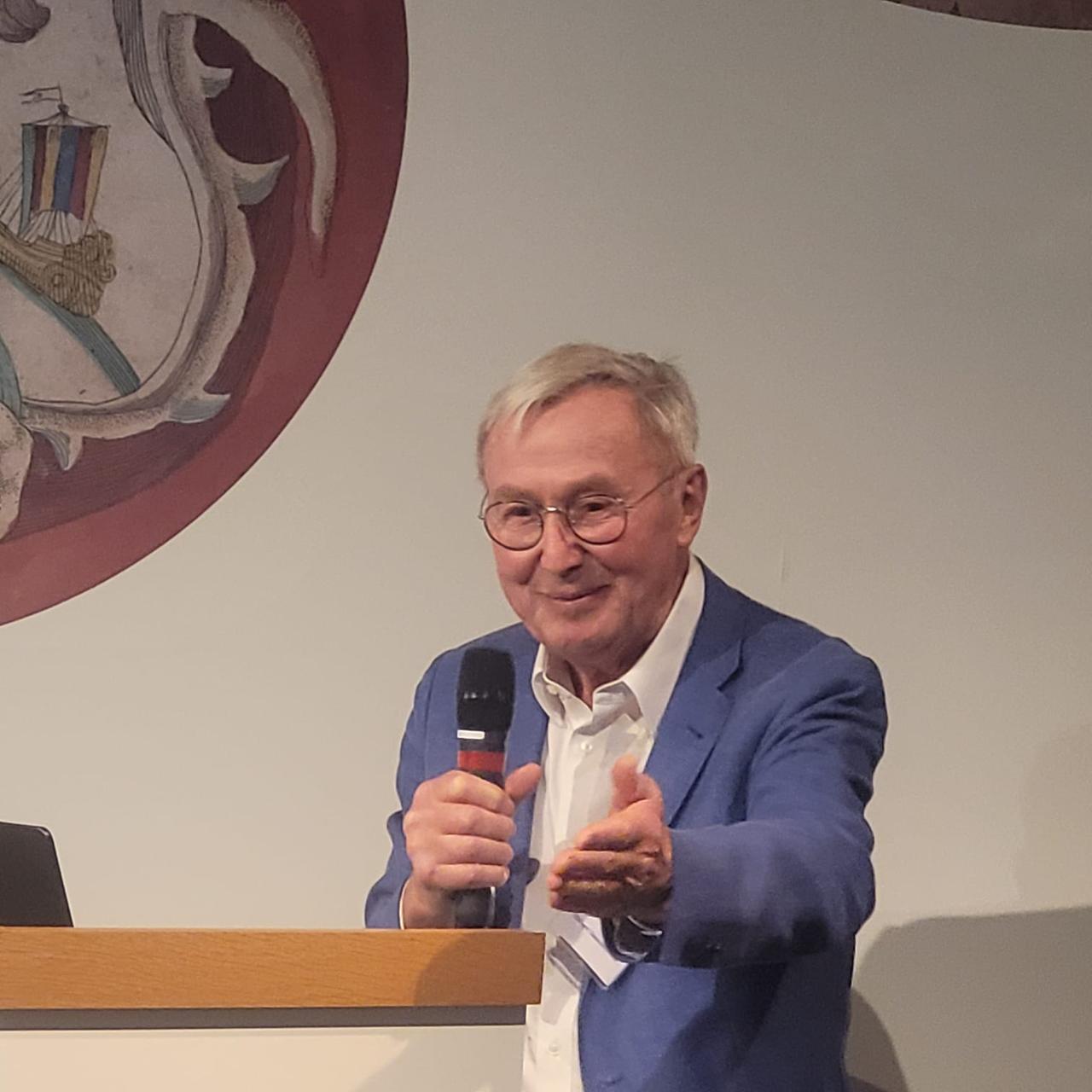
Thijs received his PhD in 1975 from Utrecht University and spent most of his career at the Groningen branch of SRON. He was alsoprofessor by special appointment at Leiden University and chair of the NOVA Instrument Steering Committee.
Thijs was a pioneer and world expert in infrared and submillimeter astronomy. His record in planning, designing, building andscientifically exploiting key innovative instrumentation is exceptional. He is best known for his achievements as PrincipalInvestigator of the Short Wavelength Spectrometer (SWS) on the Infrared Space Observatory (ISO) and of the Heterodyne Instrument for the Far Infrared (HIFI) on the Herschel Space Observatory, as well as being ALMA Director during its critical construction phase.
Under Thijs' leadership, the ISO-SWS opened up in 1995 a new spectral range, from 2--45 mm, for astronomical study. This range turned out to be full of spectral features and diagnostics of both gas, dust and ice, making the SWS one of the most scientifically productive instruments on ISO. Thirty years later, its results are still relevant as a pathfinder for JWST. Within the Netherlands, Thijs was the stimulating force in bringing the Dutch university astronomical community together to harvest the rich science.
Thijs' main passion throughout his career has been the development of heterodyne instrumentation for the submillimeter and far-infrared wavelength range. He was among the first to build receivers for the THz range and one of the major drivers in making the then European Far-InfraRed Space Telescope (FIRST, now known as Herschel) happen, an ESA Horizon 2000 cornerstone mission. He established early-on a fruitful collaboration with the solid-state physics group at Groningen (and later Delft) to develop the most sensitive SIS devices. Well before the launch of Herschel in 2009, these devices have been used and tested in submillimeter receivers on the SEST 15m dish in Chile, on the James Clerk Maxwell Telescope (JCMT) on Mauna Kea (for which Thijs played a major role in securing its location) and on the Atacama Pathfinder Experiment (APEX) on Chajnantor.
Thijs' major achievement is undoubtedly the design and building of Herschel-HIFI, one of the most complex space instruments ever flown. Thijs, with his characteristic determination and insistence on excellence, coupled with a strong dose of stubborn persistence in overcoming many challenges, led a group of more than 20 institutes and 100 co-Is throughout Europe, the US and Canada to make this instrument into a reality. The quality of the HIFI data were superb and its spectra and results will remain unique for many decades to come. In 2012 the American Astronomical Society awarded Thijs the Joseph Weber Award for Astronomical Instrumentation for his leadership in these projects.
The HIFI technology development led to a major spin-off in the building of high frequency receivers for ALMA. Through a collaboration with the Netherlands Research School for Astronomy (NOVA), Thijs helped to set up a strong instrument team in Groningen that delivered Band 9 as one of the first generation receivers, and subsequently Bands 5 and 2.
Thijs also played a major role in the early days of ALMA as part of its management and technical oversight committees. In 2008 Thijs was appointed first as Interim Director and later that year formally as ALMA Director, a position he held until just after the start of scientific operations in 2012 and the ALMA inauguration in 2013. He guided ALMA through its complex construction period, making it into the scientific machine it is today. Thijs' deep technical expertise and his ability to lead and bring together diverse cultures made him an ideal ALMA Director.
During his career, Thijs was awarded many awards and recognitions. He was particularly pleased to be the Kenneth J Button Prize recipient for 2025 for his "Outstanding Contributions to the Science of Infrared, Millimeter, and Terahertz Waves." awarded to him by the people he considered his closest colleagues (and sometime competitors).
Using his extensive experience, Thijs was invaluable in advising the NOVA instrumentation programme, serving as the chair of NOVA’s Instrument Steering Committee for many years. In particular, Thijs made a major contribution in advising the team developing the MIRI instrument for the James Webb Space telescope.
Thijs was unique: as a person, he was driven, forward looking, constructive, and always ready to help others, bringing out the best in young people and giving them opportunities to grow. His enthusiasm and optimism, coupled with a healthy sense of humor, were contagious. He successfully identified and recruited those who were needed to bring his ideas to fruition and commanded the respect and loyalty of those who worked with him; yet he was often modest and humble himself. In his final years, Thijs developed a new low-cost planetarium dome with the vision to bring astronomy education to rural areas throughout Chile. The Dutch, European and worldwide community in infrared and millimeter astronomy owe Thijs tremendously. We all will miss him hugely.
Our thoughts are with his wife Herma, daughters Jessica and Gwen, and his extended family.
Frank Israel en Ewine van Dishoeck,
on behalf of the Dutch astronomical community