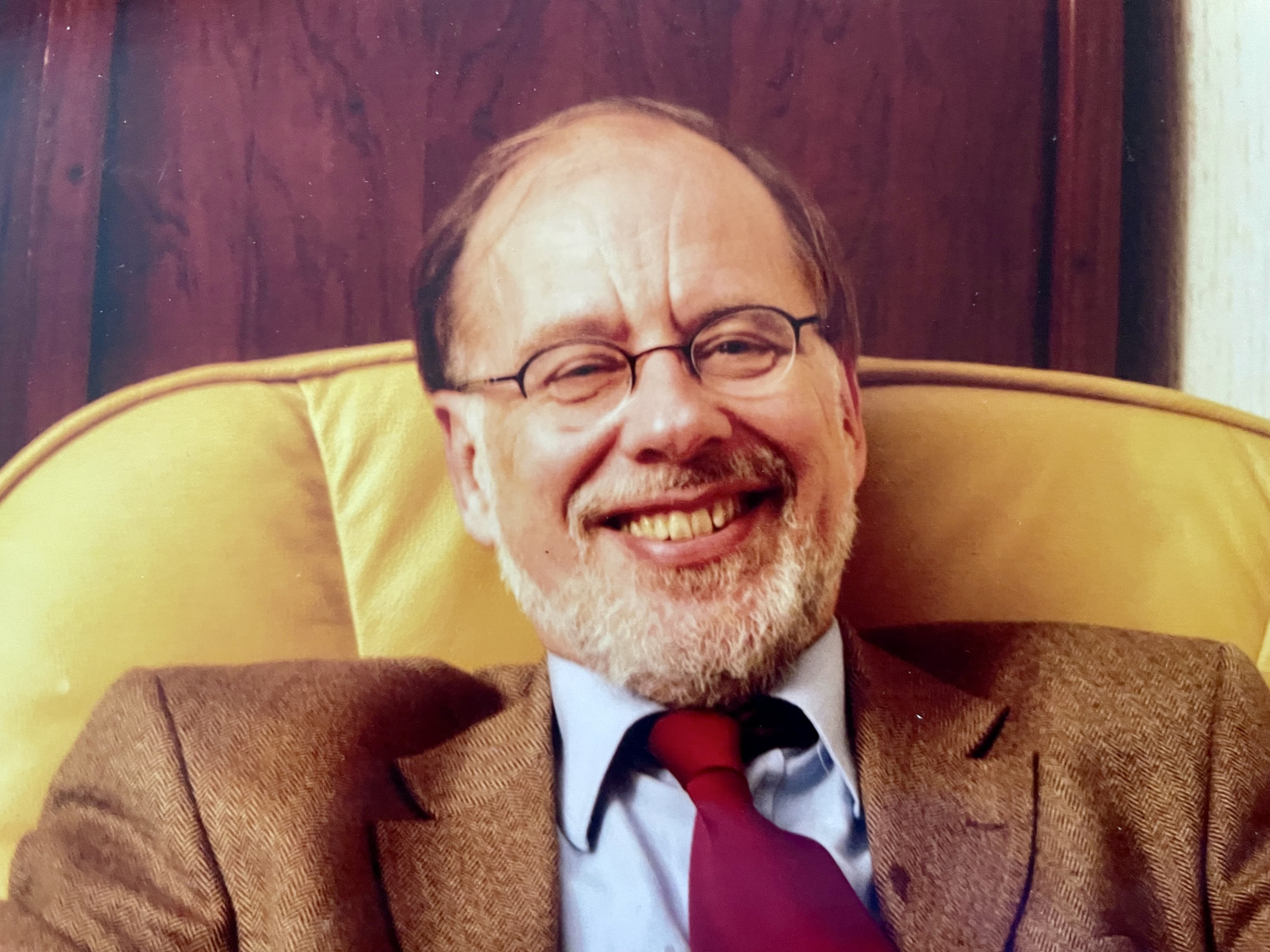
Frank was born in Delft on 31 December 1946 and attended the Stedelijk Gymnasium in Assen, where he graduated in 1965. From an early age he was fascinated by space exploration and regularly contributed articles to amateur astronomy magazines. He went on to study astronomy in Leiden and carried out his PhD research with Professor Harm Habing, working on radio observations of ionised gas. After receiving his PhD from Leiden in 1976, Frank worked from 1977 to 1980 in the United States as a researcher at the Owens Valley Radio Observatory, based at Caltech in Pasadena.
He then returned to the Netherlands to work at ESA/ESTEC in Noordwijk, where his research included millimetre and submillimetre observations of molecular gas. In the mid-1980s he returned to Leiden Observatory, where he went on to build a long research career. In 2005, Frank was appointed full professor and became Director of Education in Astronomy. He taught generations of Leiden astronomy students and supervised PhD students throughout his career. Frank became professor emeritus in 2012, but this was by no means the end of his involvement with the Observatory. He remained a familiar presence, continued his research and publications, and maintained close ties with the Leiden astronomy community.
During his PhD research, Frank already made an important contribution to our understanding of star-forming regions. He developed the so-called blister model, in which young, massive stars form close to the edge of a large cloud of gas and dust, heating the surrounding gas and driving it outward. The model explained properties of bright emission nebulae that had until then been difficult to understand. More than forty years later, a NASA visualisation of the Orion Nebula showed almost exactly the structure that Frank and his colleagues had predicted. In his later research Frank focused primarily on how stars form from gas and dust, and on how this process takes place in galaxies beyond our own Milky Way. He studied, among other systems, the Magellanic Clouds (two small nearby galaxies) as well as the central regions of larger galaxies.
An important part of his work concerned the question of how astronomers can determine how much molecular gas a galaxy contains. This gas, which consists mainly of hydrogen, provides the raw material from which new stars are formed, but is itself difficult to observe directly. Astronomers therefore often use carbon monoxide, CO, as a tracer of its presence. Frank showed that the relationship is much less straightforward than had often been assumed. In galaxies with a different chemical composition or a stronger radiation field, large amounts of molecular hydrogen can be present without producing correspondingly strong CO emission. His work thus made an important contribution to our understanding of the conditions under which stars form, and of the role that gas and dust play in the evolution of galaxies.
Frank was first and foremost an observational astronomer. Over the course of his career, he worked with virtually every major generation of radio, millimetre and, especially, submillimetre telescopes, from SEST and JCMT to Herschel, APEX and later ALMA. He followed the rapid development of the field closely, supported the development of new facilities, and consistently made use of new observing capabilities to study a wide variety of astronomical objects. This breadth of experience, with observations, instrumentation and many different types of galaxies, was characteristic of his scientific career. Right up to the end, he continued to analyse his own data and publish the results himself.
Friends and colleagues will remember Frank for his keen eye on science and on the world around him, and for the perceptive and sometimes wonderfully outspoken reflections that came with it. At the same time, he was a gifted storyteller, with a wealth of memories from his many travels and from a long life in astronomy. It was precisely this combination of scientific drive, sharpness and personal stories that made him such a familiar and distinctive presence in the Leiden Observatory community.
Frank’s sharp and critical outlook was also reflected in his long-standing involvement with Stichting Skepsis, a Dutch foundation devoted to critical, evidence-based examination of extraordinary and poorly supported claims, of which he served as chair. He cared deeply about critical thinking and about testing claims carefully against facts and evidence. Beyond science as well, he felt it was important to question unsupported claims and to engage in public debate about them. He did not shy away from discussion, even when it became heated and at times affected him personally. He approached such debates in the way many knew him: sharp, principled and with a sense of humour.
Frank was always keen to share his love of astronomy with a wider audience. He gave many public lectures and clearly took great pleasure in talking about the Universe, new discoveries, and the questions that astronomy raises. He was also a co-founder of Space Expo in Noordwijk, where he contributed to public outreach activities in astronomy and space research. In this way, he became a familiar and approachable face of astronomy for many people beyond the university.
Frank also had a deep interest in the history of astronomy, and especially in the history of Leiden Observatory and the Old Observatory. As a co-founder of the Stichting Behoud Leidse Sterrewacht, he was involved in the restoration of this iconic building. He took a particular interest in the people, instruments and events that had shaped the development of astronomy, and he also wrote about them. For Frank, this historical interest was a natural part of his close connection with Leiden astronomy. With his broad knowledge and remarkable memory, he was often able to bring these stories to life for colleagues and students in a personal and vivid way.
Frank was such a constant presence at the Observatory that one almost expected to see his familiar figure and hear his characteristic short laugh at any moment. It is difficult to imagine the Observatory without him. We will remember him with great affection and will miss him deeply.
Ignas Snellen, Director Leiden Observatory