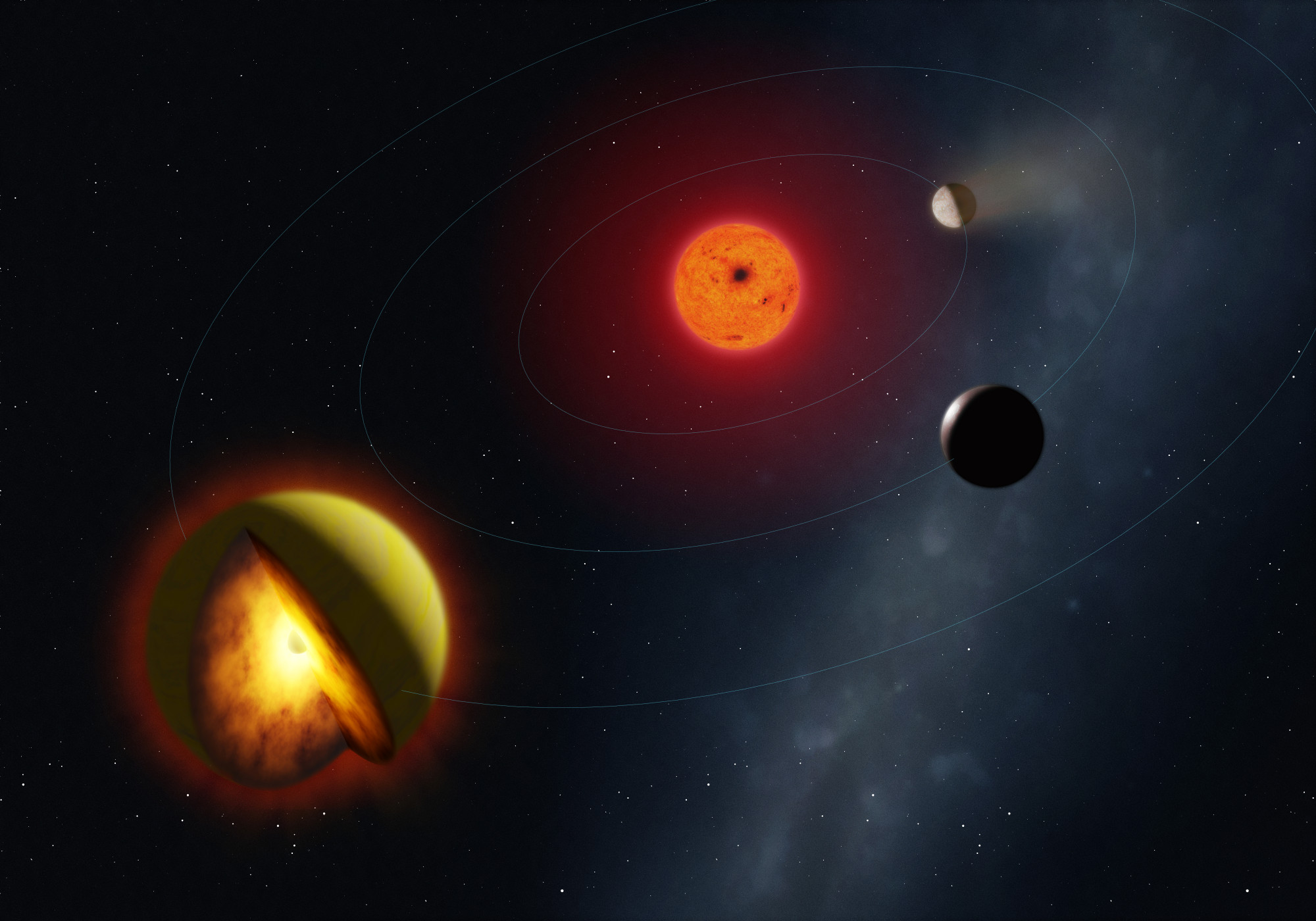
To explain the planet's properties, the scientists simulated the development of L 98-59 d from the moment of its formation some five billion years ago. Their computer model – PROTEUS – calculates interactions between the planet’s deep interior and its atmosphere over billions of years. These simulations take into account intense ultraviolet radiation that the planet receives from its star and the internal chemical and physical evolution. These processes mutually interacted to shape the appearance of the planet today.
The simulations, combined with observations, show that the surface of L 98-59 d is extremely hot and must be covered by a global ocean of magma in which a large amount of sulphur is stored. JWST observations have detected hydrogen sulphide and sulphur dioxide high in the planet's atmosphere, the first detection of sulphur on a planet of this size. This was very recently supported by detections of hydrogen sulphide in the same planet, using ground-based telescopes on Earth. According to the scientists, this sulphur degassed from the magma ocean and was then converted into sulphur dioxide in the atmosphere under the influence of ultraviolet radiation.
Remarkably, the “sulphur planet” does not fall into any of the known categories for planets of this size. According to the researchers, the population of this dominant super-Earth population of exoplanets may be more diverse than previously assumed. The research was published today in the journal Nature Astronomy and highlights the deep influence of the internal geophysical processes on the climates of super-Earths.
New category of super-Earths
Exoplanets with a diameter between 1.5 and 4 times that of Earth have previously been interpreted to be formed in roughly two categories. They are thought to form as either rocky planets with a hydrogen-rich atmosphere (‘gas-dwarfs’), or instead have steam atmospheres and a large amount of water in their interiors (‘water-worlds’). However, based on its atmospheric composition and density, L 98-59 d does not seem to fit into either of these categories.
From their computer analysis, the scientists conclude that they have characterised the first planet of a new class of super-Earth which form and evolve in a manner fundamentally different from the gas-dwarfs and water-worlds. ‘The measurements and simulations of L 98-59 d show that super-Earths are probably far more diverse than previously assumed,’ says Tim Lichtenberg, assistant professor of the Kapteyn Institute of the University of Groningen, and co-author of the scientific article.
Uninhabitable magma world
L 98-59 d was discovered in 2019 by the TESS space telescope. L 98-59 is a dwarf star with five known planets. The planetary system is located just under 35 light-years from the Solar System in the southern constellation of Piscis Austrinus.
Given the distance, it is impossible to visit these exoplanets. Astronomers must rely on observations – in this case, by JWST and the Very Large Telescope in Chile. ‘These kinds of observations provide information about global properties such as the size and mass of the planet and the composition of its atmosphere,’ says Lichtenberg. ‘Through the development of increasingly realistic computer models of exoplanet climate evolution, we are now at a stage where we can start understanding the interior of exoplanets and their formation history.’
The astronomers now want to apply their simulations to data from other exoplanets to better understand which planets could resemble Earth and which ones are in an extreme molten stage. ‘With our simulation model PROTEUS we can determine the formation history of many more planets with different compositions and climate histories,’ says Lichtenberg. ‘These analyses can provide information about whether the surfaces of these worlds are theoretically suitable for life as we know it or not.’ Because of its molten surface, the chances of extraterrestrial life on L 98-59 d seem slim.
JWST is currently providing a wealth of new information about exoplanets, which will be further supplemented in the coming years by the ground-based Extremely Large Telescope, and the Ariel and PLATO space missions. This may reveal more new types of exoplanets, entirely unlike the planets in the Solar System, and probe their climate and interior properties.
‘Our research into this molten sulphur world is representative of a new era in planetary science, in which we are discovering new families of planets and overturning our understanding of planetary evolution as a whole,’ concludes Harrison Nicholls, first author of the study, who recently graduated with a PhD from Oxford University and now works as a postdoc at the University of Cambridge.