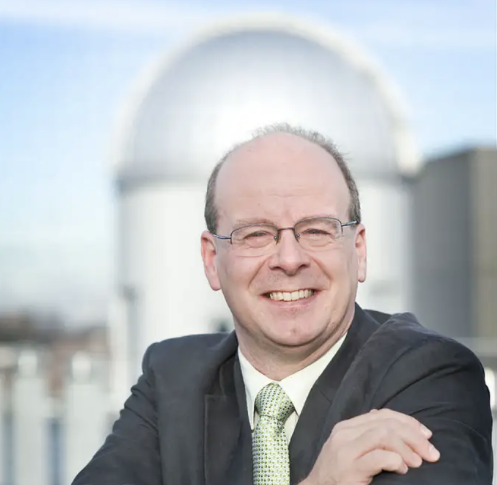
Ralph Wijers was born in Sittard on 31 May 1964 and spent, after a few years in Zuid Limburg, his childhood in Roosendaal. From an early age, astronomy was an important part of his life, both at the Norbertus College, during Walter Wamsteker’s lessons, and at the Simon Stevin Public Observatory in Hoeven. After secondary school, Ralph went on to study astronomy in Leiden, where he graduated cum laude in 1987. In the same year, he joined the University of Amsterdam to study neutron stars, under the supervision of Jan van Paradijs and Ed van den Heuvel. In 1991, he was awarded his PhD for a thesis entitled “On the Properties and Evolution of Binary and Single Neutron Stars”. It was clear that Ralph was well on his way to turning his hobby into his profession.
As a young PhD graduate, and now married to Astrid, Ralph moved to the United States in 1991 for a Compton GRO and Spitzer post-doctoral fellowship at Princeton University. Their daughter Nastasha (1993) was born there. In 1994, the family moved to the United Kingdom, where Ralph worked at the Institute of Astronomy at the University of Cambridge until 1998. Shortly after the move their daughter Naomi (1994) was born. By this time, he had become closely involved in the study of gamma-ray bursts (GRBs) – mysterious bursts of gamma radiation from space that had been discovered in the 1970s, but whose physical origin remained unclear. It was extremely difficult to determine the precise location of GRBs on the sky and, consequently, to obtain information about their distance. It gradually became clear, however, that GRBs must have a cosmological origin. In Cambridge, Martin Rees and Peter Mészáros had developed a promising theory, the so-called relativistic fireball model, which might explain the GRB phenomenon.
With the discovery (in Amsterdam) of the first optical afterglow of a GRB in 1997, Ralph immediately realised that the relativistic fireball model provided a good description of the observations. His subsequent paper with Rees and Mészáros demonstrated that the afterglow of a GRB is caused by a shock wave propagating through the surrounding medium at relativistic speeds, which would be visible at cosmological distances. The eventual measurement of the redshift – and thus the distance – of a GRB, confirmed this interpretation.
Meanwhile, Ralph had been offered a faculty position at Stony Brook University in New York, USA, and he and his family moved once again to the other side of the Atlantic. Research into GRBs took off in a big way, with Ralph and his research group pioneering the theoretical interpretation of the spectra of the afterglows and their light curves, for the first time testing and confirming these models based on the observations. He was one of the initiators and driving forces within the GRACE team that organised observing campaigns of GRB afterglows using the ESO telescopes in Chile, to measure the physical parameters of GRBs. His theoretical knowledge proved to be a huge advantage. During these hectic and successful years, it became clear that (long) GRBs are caused by the collapse of massive stars into a black hole, with highly collimated, relativistic jets producing the observed gamma-rays. For this major scientific breakthrough, the GRACE team was awarded the European Union’s Descartes Prize in 2002.
As a key figure in the theoretical unravelling of the physical causes of GRBs, Ralph was the obvious choice to succeed Jan van Paradijs in Amsterdam, when Jan passed away in 1999; in 2002, Ralph became a professor at the Anton Pannekoek Institute for Atronomy (API) at the University of Amsterdam, Netherlands.
In later years, it would become clear that the so-called short GRBs are caused by the merging of binary neutron stars. Ralph contributed to many scientific publications on all types of GRBs. In total, he published more than 550 scientific articles, supervising more than 30 PhD students and 20 postdocs.
On his return to Amsterdam, Ralph also became involved in radio astronomy, particularly in the development of the Low Frequency Radio ARray (LOFAR) and the Transients Key project. With the support of his ERC Advanced Grant, awarded in 2010, he was able to establish AARTFAAC: the Amsterdam-ASTRON Radio Transient Facility And Analysis Centre: Probing the Extremes of Astrophysics. He also held various senior roles in this field: he was chair of the LOFAR Astronomy Research Committee, a member of the ASTRON Scientific Advisory Board and chair of the ASTRONET European Radio Telescope Review Committee.
In 2011, with great enthusiasm and energy, he took over the directorship of the Anton Pannekoek Institute for Astronomy from Michiel van der Klis, thereby also becoming a member of the board of the Netherlands Research School for Astronomy (NOVA) and chair of the Netherlands Committee for Astronomy (NCA, now the Council for Astronomy). He also was a member of the SRON board for ten years. During his ten-year tenure as API director, the number of staff members doubled, and at the end of his term we celebrated API’s 100th anniversary.
Ralph was deeply committed to education; at Stony Brook, he taught the Astronomy 101 course, for students without a background in the natural sciences. In Amsterdam, he developed and delivered various courses within the Bachelor and Master’s programmes. Most recently he developed a new course to teach students how to solve scientific problems by making order of magnitude estimates. And, of course, he supervised many students on their final research projects, drawing on his considerable knowledge of mathematics and physics.
Ralph also had a keen eye for students from less privileged backgrounds. He was particularly proud of the ASPIRE Summer School, where Master’s students from countries with more limited opportunities for a career in astronomy spend eight weeks working on a research project at API. ASPIRE receives many hundreds of applications each year, from which a select few are chosen; Ralph co-ordinated this programme and secured the necessary financial support. Many of these students have subsequently succeeded in securing a PhD position, thanks in part to ASPIRE.
Ralph’s commitment to open access also fits this picture. He served for many years as an Editor of MNRAS and New Astronomy Reviews and, in recent years, played a central role within arXiv: a repository of scientific articles accessible to anyone. arXiv enables scientists to access new scientific findings without the need for expensive journal subscriptions. In 2025, Ralph accepted the Jocelyn Bell Burnell Inspiration Medal on behalf of arXiv at the annual meeting of the European Astronomical Society, in recognition of the important role it plays in making scientific publications accessible.
What was already evident during his youth was the importance Ralph attached to popularising science and making scientific findings accessible to a wider audience. He gave many popular lectures and was very actively involved in numerous outreach activities. His enthusiasm was infectious.
Ralph’s scientific, managerial and organisational abilities were also recognised by various scientific bodies: he was a member (and board member) of the Royal Dutch Astronomers’ Club, the Dutch Physical Society, the International Astronomical Union, the Royal Holland Society of Sciences, the Royal Netherlands Academy of Arts and Sciences, and the Academia Europaea. Ralph was also a distinguished professor at George Washington University in the US.
You always knew when Ralph was around; and by that, I mean not only his distinctive voice, but also the time he took to pop into your office and enquire about the latest developments, both scientific and personal. It is literally and figuratively quieter without Ralph; we thank him for his boundless dedication to API, Dutch astronomy, science and society. We will miss him enormously.
By Lex Kaper, Director of the Anton Pannekoek Institute for Astronomy, University of Amsterdam