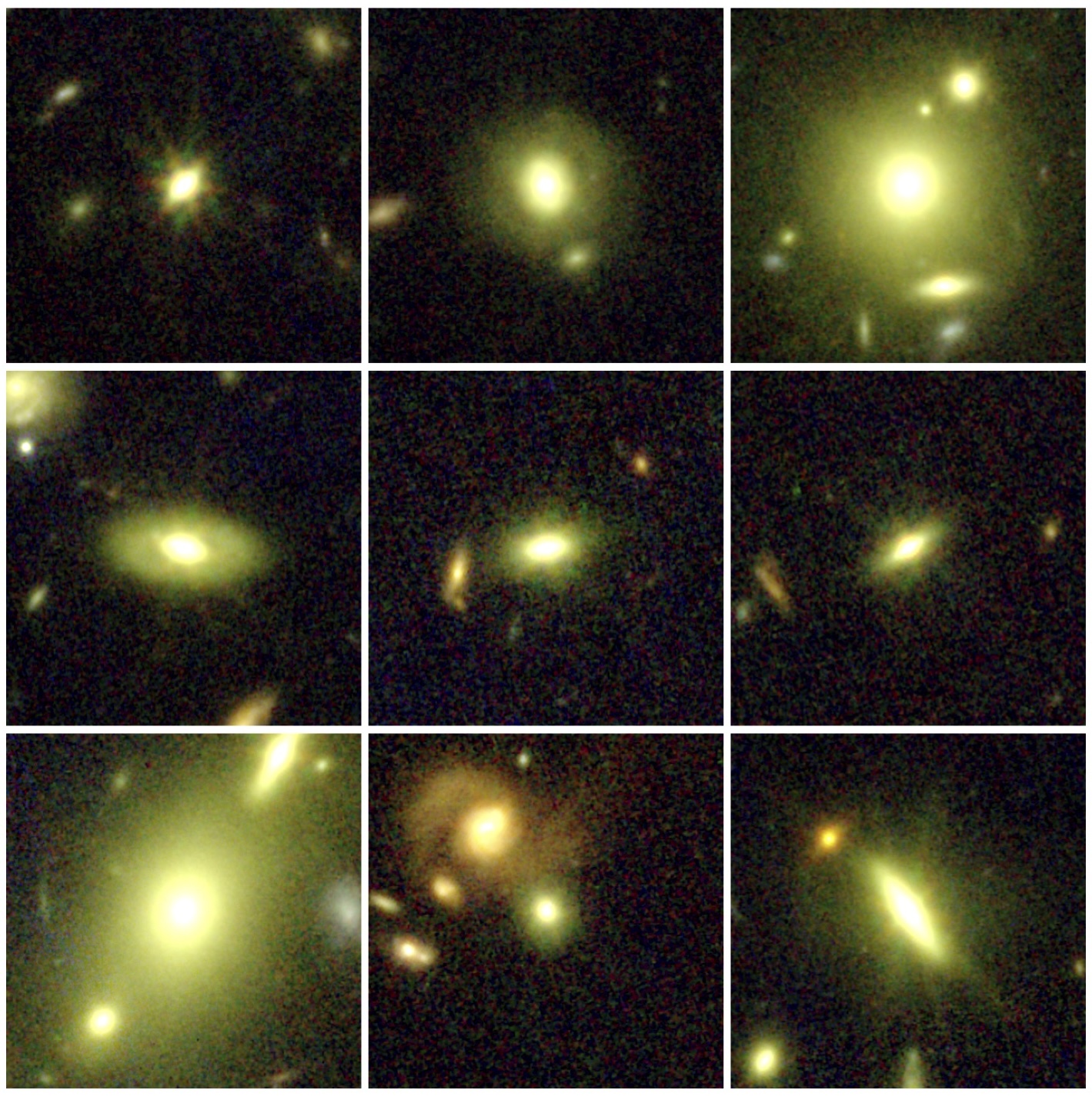
An international team of researchers led by scientists at Leiden University leveraged the James Webb Space Telescope (JWST) to make this discovery. The team studied nine massive, mature galaxies that ceased forming stars billions of years ago, combining extremely deep JWST spectra with previous ground-based observations from the Very Large Telescope. The researchers used these observations to reliably determine the proportions of tiny, faint stars and giant, bright stars present in such distant galaxies for the first time.
To achieve these measurements, astronomers split the light from a galaxy into a spectrum, in which subtle differences in colour reveal the types of stars within the galaxy. This spectrum is typically dominated by massive, bright stars, making the much fainter, low-mass stars extremely challenging to detect. “If a galaxy were a city, the brightest stars would be the skyscrapers that immediately catch your eye from afar”, says lead author Chloe Cheng (Leiden University), who earned her PhD in June based in part on this research. “Our models demonstrate that a far more numerous population of low-mass stars is concealed by those rare, bright stars, like houses hidden between skyscrapers. As a result, this galaxy turns out to be much more massive than previous estimates suggested.”
To estimate the unseen mass locked up in small, faint stars, astronomers historically assumed that stars formed in roughly the same proportions everywhere in the universe. These new results challenge that assumption and show that the most massive galaxies in the early universe contain a much larger fraction of low-mass stars than less massive galaxies, such as our own Milky Way. For one of the galaxies in the sample, the effect is particularly striking. That galaxy likely formed less than one and a half billion years after the Big Bang and may be as much as four times more massive than previous estimates indicated.
“Until recently, measurements like these were simply impossible”, says co-author Martje Slob (Leiden University). “We needed not only a telescope capable of magnifying very distant galaxies, but also spectra of exceptional quality and new analysis techniques to reliably detect the subtle signatures of faint, low-mass stars hidden within these cosmic titans.”
Surprisingly massive and mature galaxies
This discovery has crucial implications for our understanding of the early universe. Since the launch of JWST, astronomers have found surprisingly massive and mature galaxies that already existed shortly after the Big Bang. These new results suggest that these galaxies were probably even more massive than originally reported. Models of galaxy formation must now explain how such vast quantities of tiny stars could have formed so early in the history of the universe.
“This result shows that much more mass than previously thought is hidden in low-mass stars”, says Mariska Kriek (Leiden University), who led the research. “That has consequences for many areas of astronomy. For example, as many planets orbit low-mass stars, this could even indicate that more planets formed in the early universe than we had previously assumed.”
In the next few years, the researchers plan to apply their method to even earlier galaxies. In doing so, they hope to probe closer to the era when the first generations of stars and galaxies formed.