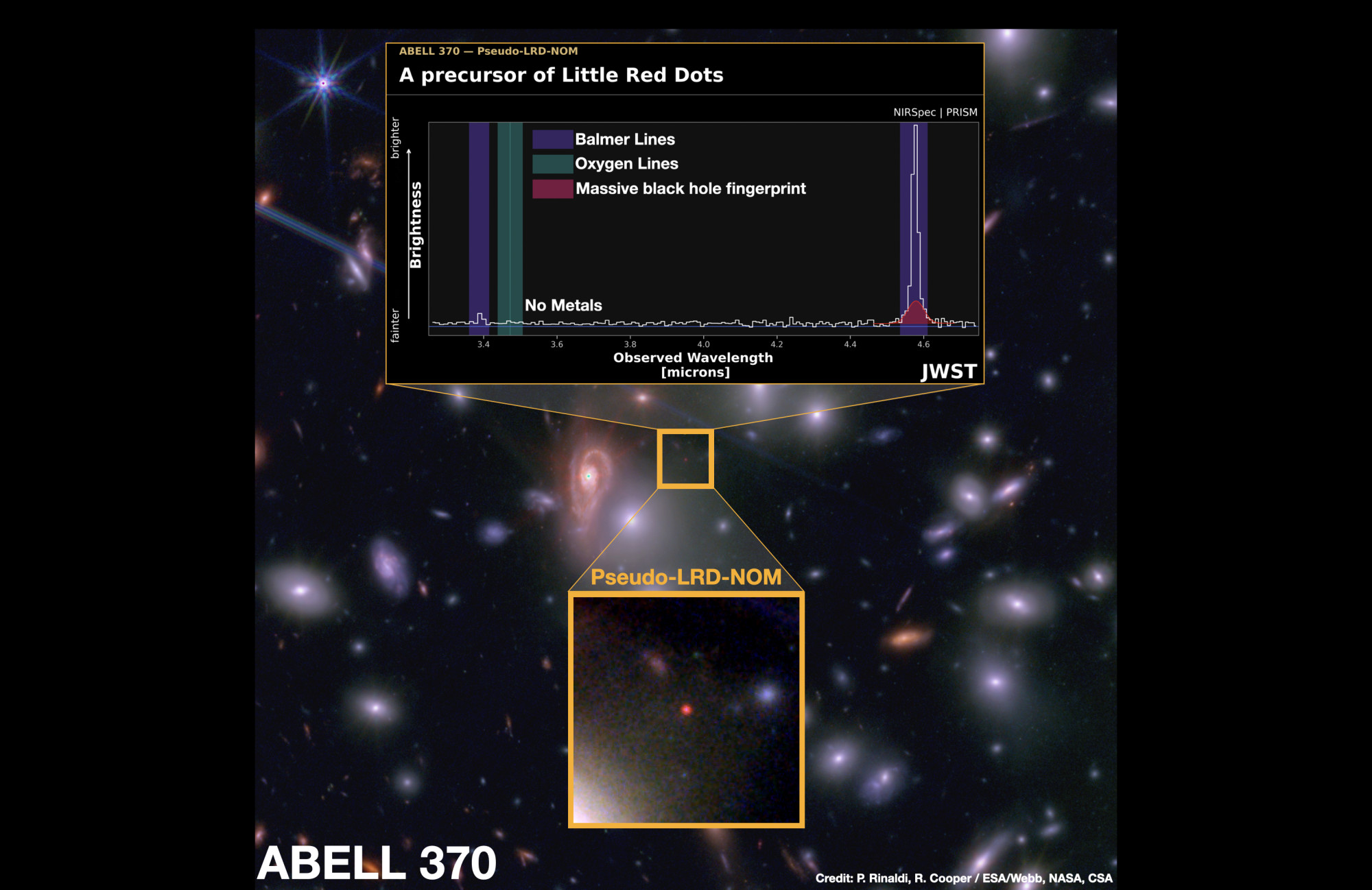
Little Red Dots (LRDs) contain massive, active black holes whose presence is difficult to explain so early in cosmic time. Understanding how those objects have formed is currently one of the most important questions in extragalactic astronomy.
The source found by Caputi and colleagues is a small so-called starburst galaxy caught within the first 10 million years of formation. This galaxy is forming stars at a rapid rate. It is so young and dense that the JWST spectrum only shows Balmer emission lines, which are those produced by hydrogen transitions, but no metal lines at all.
The astronomers conclude that it is the precursor to an LRD because this small galaxy contains an active black hole which is already massive. This suggests that this black hole could have been formed before the surrounding galaxy, as it is believed to happen in LRDs. The rapid formation of stars helps the black hole grow further by facilitating the funnelling of fresh gas from the dark-matter halo – an area surrounding the galaxy containing dark matter – towards the centre. This is caused by the action of gravity.
The source is at redshift z=6, which means that its light was emitted only one billion years after the Big Bang (the universe is 13.8 billion years old now) and has been detected because its light is magnified 16 times by the effect of gravitational lensing from a galaxy cluster in the foreground.
Caputi and her colleagues have been studying many small distant galaxies with the JWST. Most of them have spectra with multiple emission lines. The spectrum of this source caught their attention due to the absolute lack of metal lines, which is extremely rare in star forming galaxies because metals are produced very quickly when there is new star formation.
Caputi sees the discovery as ‘a fundamental step to understand the formation of LRDs’. The team is now planning follow-up observations with JWST and the ALMA Observatory in Chile.