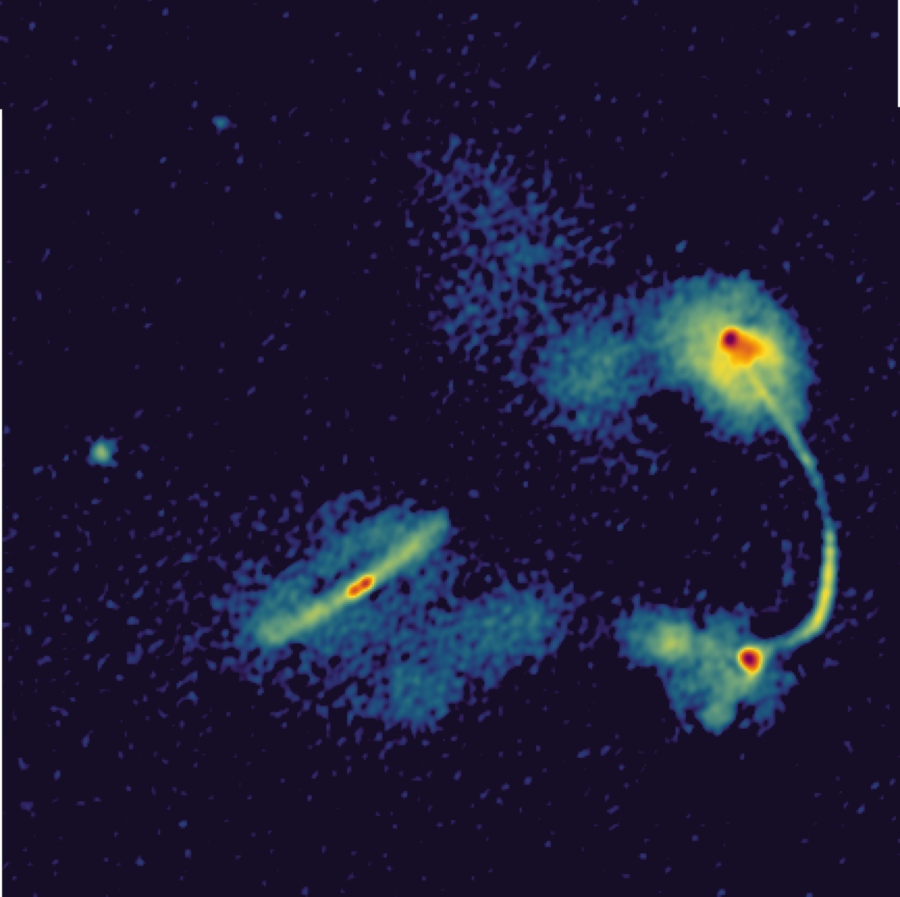
The researchers have observed ELAIS-N1, a well-studied patch of the northern sky that contains many faint and distant galaxies. The image is twenty times sharper than the previous most sensitive LOFAR image of this area of sky. For comparison: the resolution of the image is high enough to pick out a coin from about ten kilometres away. At this resolution, the full image contains 8 billion pixels.
The data for the image was collected over 200 hours and amounted to 400 terabytes. For years, processing that much data for a single 8-billion-pixel image with radio telescopes at such high resolution was impossible, but improved calibration and data-reduction methods developed by the team and collaborators have cut the cost by more than a factor of ten in the past few years. “The entire dataset could be processed on Spider, the high-performance data processing platform hosted at SURF in the Netherlands, in just a few months”, says Jurjen de Jong, who led this work and is a postdoctoral researcher at Leiden Observatory and ASTRON.
The data has been made publicly available for the astronomical community, as much of the scientific value of the new data set will come from combining these observations with images of the same patch of sky taken by other telescopes at other wavelengths, like optical, infrared and X-ray observations. With this, astronomers can derive properties such as the distance and mass of each radio source detected in the new image.
Radio jets powered by black holes
One of the dominant populations in the new LOFAR image are active galactic nuclei: the compact luminous centres of galaxies, powered by matter spiraling onto a supermassive black hole. These can drive powerful jet-like outflows, which radio telescopes like LOFAR are especially well suited to detect, due to the telescope’s sensitivity to extended faint radio emission.
On low resolution images distant galaxies and these black hole-driven radio jets are featureless blobs, and it’s often hard to tell whether they consist of multiple galaxies or components. It’s also hard to tell if this radio emission comes from a jet or from star formation across the galaxy. In the new high resolution LOFAR data different components and the source of radio emission can be told apart easier, and massive jets can be traced in detail. “With this sharp and sensitive view of our sky at low radio frequencies, we have a new window to study how these radio jets interact with their environment and how they evolve over cosmic time”, says Reinout van Weeren, Associate Professor at Leiden Observatory and coauthor of the paper.
The other major population of sources in the image are small star-forming galaxies, which are actively converting gas into stars. Since radio waves can pass through the dust that hides star formation for optical or infrared telescopes, these sensitive radio observations give an unobscured picture of these processes in distant galaxies. This allows astronomers to study the evolution from the earliest galaxies up to the current Universe.
More sensitive and wider images with LOFAR2.0
According to the scientists this work demonstrates the potential of LOFAR2.0, the upgrade of the telescope that ASTRON is currently carrying out together with its European partners. It will make more sensitive and wider images at high resolution possible. De Jong says that this image demonstrates that LOFAR2.0 will remain competitive during the era of the upcoming Square Kilometre Array, the sensitive and large radio observatory now under construction in South-Africa and Australia.
Preprint of the scientific paper
This video flies through the ELAIS-N1 deep field, seen through LOFAR's low-frequency radio eyes. Credit: De Jong et al.