Almost a century ago, astronomer Edwin Hubble discovered that virtually all galaxies are moving away from the Milky Way. This is important evidence for the expansion of the universe and for the Big Bang. But even in Hubble's time, it was clear that there were exceptions. For example, our neighbouring galaxy, Andromeda, is moving towards us at a speed of about 100 kilometres per second.
In fact, for half a century, astronomers have been wondering why most large nearby galaxies – with the exception of Andromeda – are moving away from us and do not seem to be affected by the mass and gravity of the so-called Local Group (the Milky Way, the Andromeda Galaxy and dozens of smaller galaxies).
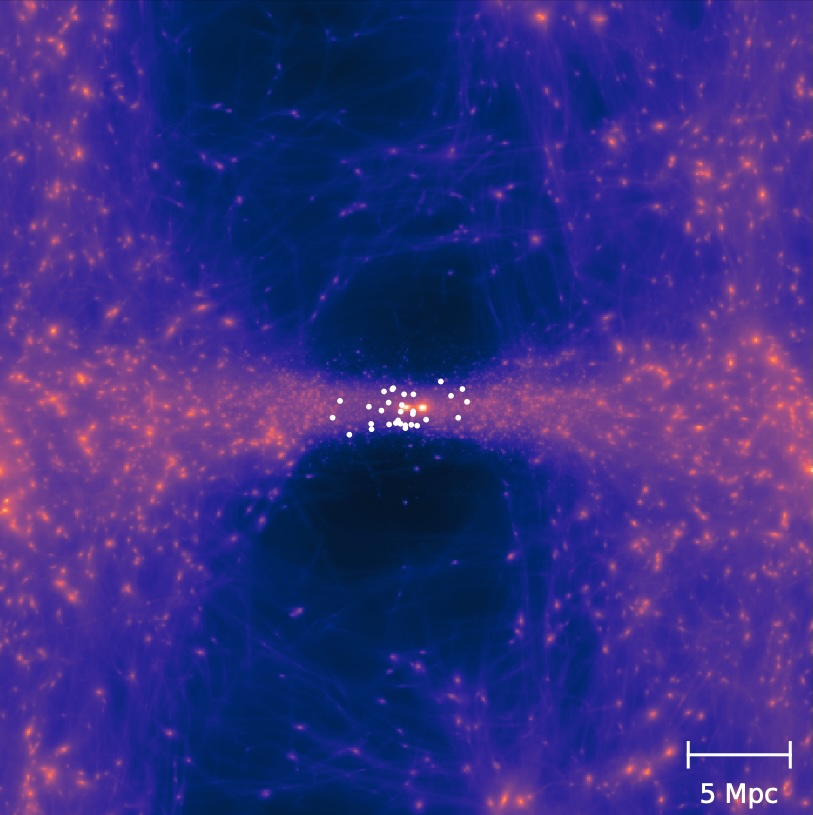
An international team of scientists led by PhD graduate Ewoud Wempe of the Kapteyn Institute in Groningen has found the solution to this puzzle. Computer simulations show that the mass distribution just slightly beyond the Local Group, including the invisible dark matter surrounding galaxies, is organised in a flat structure that extends tens of millions of light-years. Above and below this sheet are large voids. This solution found by the computer reproduces well the distribution and velocities of the observed galaxies around us.
A ‘virtual twin’ of the Local Group
The algorithm started from regions in the early universe, with a mass distribution based on observations of the cosmic microwave background. With a powerful computer the model then evolved to reproduce the present-day characteristics of the Local Group, with the mass, position and velocity of the Milky Way and the Andromeda Galaxy, and the positions and velocities of 31 galaxies just outside the Local Group. This resulted in the creation of simulations that may be considered ‘virtual twins’ of our cosmic environment.
Such simulations reproduced well the observed velocities of the 31 surrounding galaxies that are moving away from us and closely follow the Hubble-Lemaître law, despite the large mass of the Local Group. They are also found to be embedded in a large-scale sheet of dark matter.
The scientists say there are two reasons why locally there are so few deviations from the Hubble-Lemaître law. For nearby galaxies in the sheet, the gravitational pull of the Local Group is counteracted by the mass further away in the plane. And the places where you would expect matter to be moving towards us (in the voids) are in fact ‘invisible’ because galaxies are absent.
According to lead researcher Ewoud Wempe, this is the first assessment of the distribution and velocity of dark matter in the region surrounding the Milky Way and the Andromeda Galaxy. “We are exploring all possible local configurations of the early universe that ultimately could lead to the Local Group. It is great that that we now have a model that is consistent with the current cosmological model on the one hand, and with the dynamics of our local environment on the other.”
Amina Helmi is also very pleased with the discovery. According to her, astronomers have been trying to solve this problem for decades without success. “I am excited to see that, based purely on the motions of galaxies, we can determine a mass distribution that corresponds to the positions of galaxies within and just outside the Local Group.”